From ceramics to racecars
Scholars Day celebrates Monmouth College students' research, creativity
Monmouth, Ill. (04/29/2026) — Scholars Day 2026 at Monmouth College offered a little bit of everything - faculty in academic regalia at the Honors Convocation, scores of examples of students' academic research at the afternoon poster presentations, live music at both events - and even a cool, refreshing drink.
"Where else can you watch a ceramics demonstration right across from research about the metal in racecars, all while drinking lemonade?" said Monmouth President Patricia Draves.
She continued: "One of the things we take pride in here is our students' experiences and how involved they are inside and outside the classroom. Today we celebrate their ongoing research and their ongoing creative works. They're able to show those things off and interact with the campus and local community, answering questions. To me, that's such a major component of Scholars Day."
"It's a really diverse collection of research," said Monmouth staff member Tim Bridge after walking through the concourse in the Huff Athletic Center, where more than 100 research projects were on display, most in the form of posters. "It covered everything from the scientific formula for Kevlar to Batman's feelings. It shows how smart our students really are."
During an "Outside the Lab" podcast segment with Turner Plumer, this reporter also singled out the Kevlar research when asked to name a favorite poster. Diplomatically, three were named, with classics research on an ancient plague in Athens and the senior engineering project of an autonomous golf ball picker also cited.
Titled "Kevlar: The Fiber That Changed Safety Forever," Cade Farquer did a deep dive into the material that is used in such items as bullet-proof vests, spacecrafts and even tires. The engineering student reported that the material was discovered by accident in 1965 by chemist Stephanie Kwolek. It was certainly a happy accident, as the material has "immense durability" and is five times stronger than steel at equal weight.
The golf ball picker also came from engineering students. Ella Goodrich and Braeden Brauman represented the nine seniors who've worked on the project all year, split into groups overseeing the machine's electrical, mechanical and software components. A late change in the latter area means the students will be working right up until the very end of the spring semester.
Said Goodrich: "We've had to make a few design changes, including moving from a PLC (Programmable Logic Controller) to Raspberry Pi," a low-cost, credit-card-sized, single-board computer which can act as a PLC by running specific software.
"We haven't had it out on the golf course yet," added Goodrich, who was asked with what degree of certainty the machine would be up and running by graduation. "Out of 10, I'd say an 8."
"Yeah, an 8 sounds about right," said Brauman, adding, "As long as something doesn't go terribly wrong."
Research on the road
The research into the plague in ancient Athens was conducted by Ella D'Incognito, who reported the 430-426 BCE event caused a mass breakdown in moral values. Some of the research she cited was the writings of historian Thucydides, one of the fortunate two-thirds of Athens' population who lived through the plague, which occurred during the Peloponnesian War. He wrote that morals both lost their definition and their importance, and D'Incognito stressed that people gave up on trying to follow moral laws, believing that death was imminent, and instead focused on immediate gratification.
The sophomore was one of several students who had multiple posters on display, and she's also one of several who has presented her research off campus. Along with psychology professor Alec Stinnett, D'Incognito has attended two conferences in Chicago this semester to present her "dark romance" research, which is officially titled "Consuming Obsession: The Effect of Dark Romance on Perceptions of Toxic Romantic Behaviors." One event was the national meeting of the Society for Personality and Social Psychology and the other was a meeting of the Midwestern Psychological Association.
Another example is Cassandra Nolasco, who earlier this year won a national award from Blue Key for her biochemistry/neuroscience research, titled "The Effects of Sildenafil (Viagra) on the Progression of Alzheimer's Disease."
Outgoing Scots Student Senate president Joey Twardowski staffed a poster that showcased the highlights from the year in student government, with one of the major accomplishments being a 100% increase in attendance at full body meetings. At the end of the afternoon, next year's executive committee was announced. It will include: president - Sydney Burge; vice president - Zack Manley; parliamentarian - Riley King; secretary - Danielle Johnson; treasurer - Larry Kamara; student engagement - Brody Dolbeare; public relations - Lexi Serpette; and intercultural affairs - Addison Zamora.
"We hope next year's officers can build on the momentum we have going," said Twardowski.
Some of the other interesting and unusual topics covered by the students were ancient cosmetics, a portable livestock watering system and finding music in rural places.
"It was an awesome event," said faculty member Saad Bashir, one of the lead organizers of Scholars Day. "The boundless creativity and intellectual depth displayed by our student scholars makes this event so special."
Honors Convocation
During the morning's Honors Convocation, D'Incognito, last year's Freshman Woman of the Year, was one of several students who received multiple awards. One of the leaders in that category was Bronte de Zwart, who claimed the Senior Woman of the Year honor and the M.P. Phelps Award for all around excellence, as well as awards in physics and classics.
The other students to receive the high freshman and senior honors were Lexi Serpette, Freshman Woman of the Year, and Shane Anderson and Cadan De Jong, Senior and Freshman Man of the Year, respectively.
Media Attachments
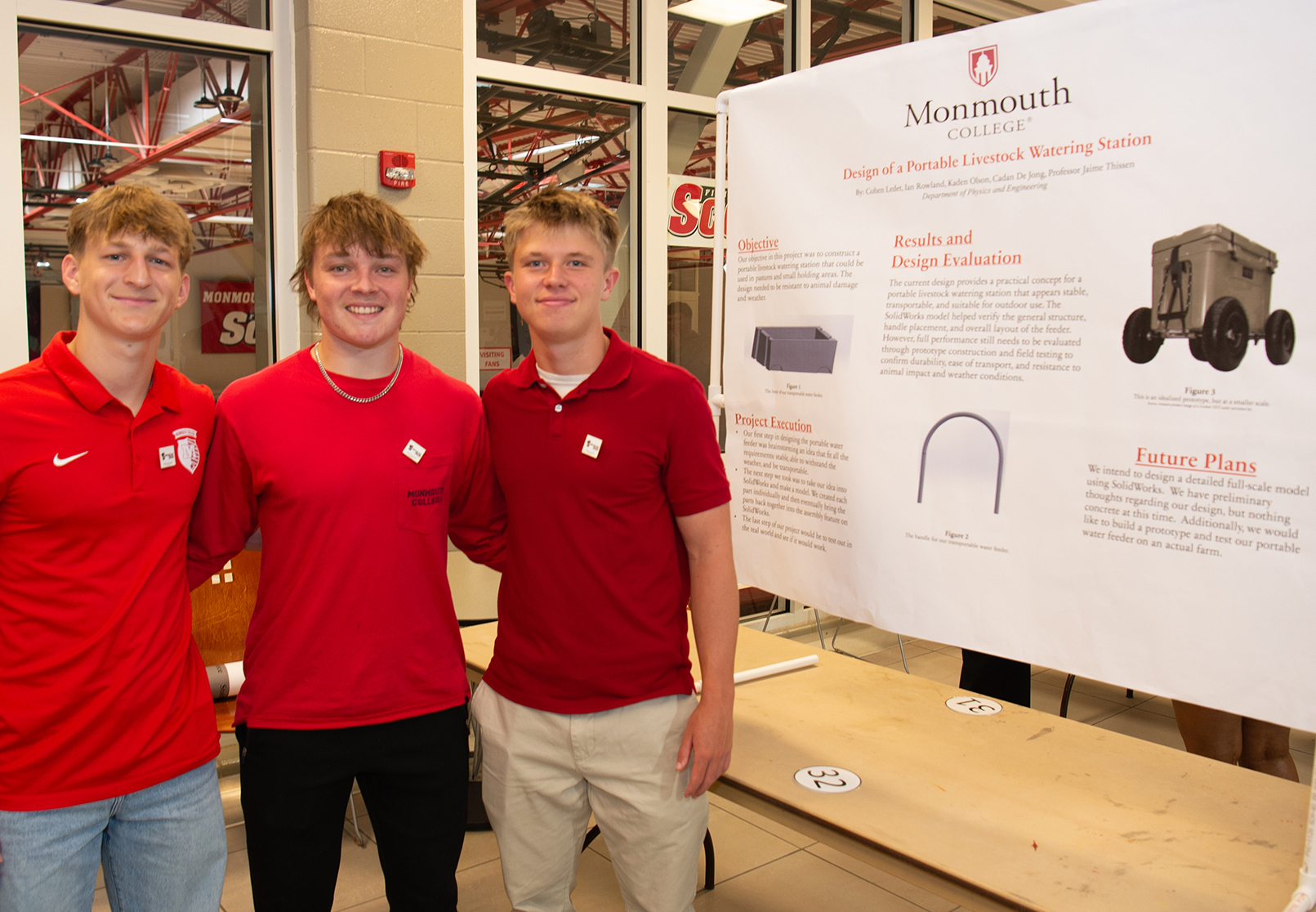
REAL-WORLD RESEARCH: From left, Cohen Ledet, Kaden Olsen and Cadan De Jong showed off their project, which is titled "Development of a Portable Livestock Watering Station for Pasture and Pen Use." Not pictured is the fourth member of their team, Ian Rowland.
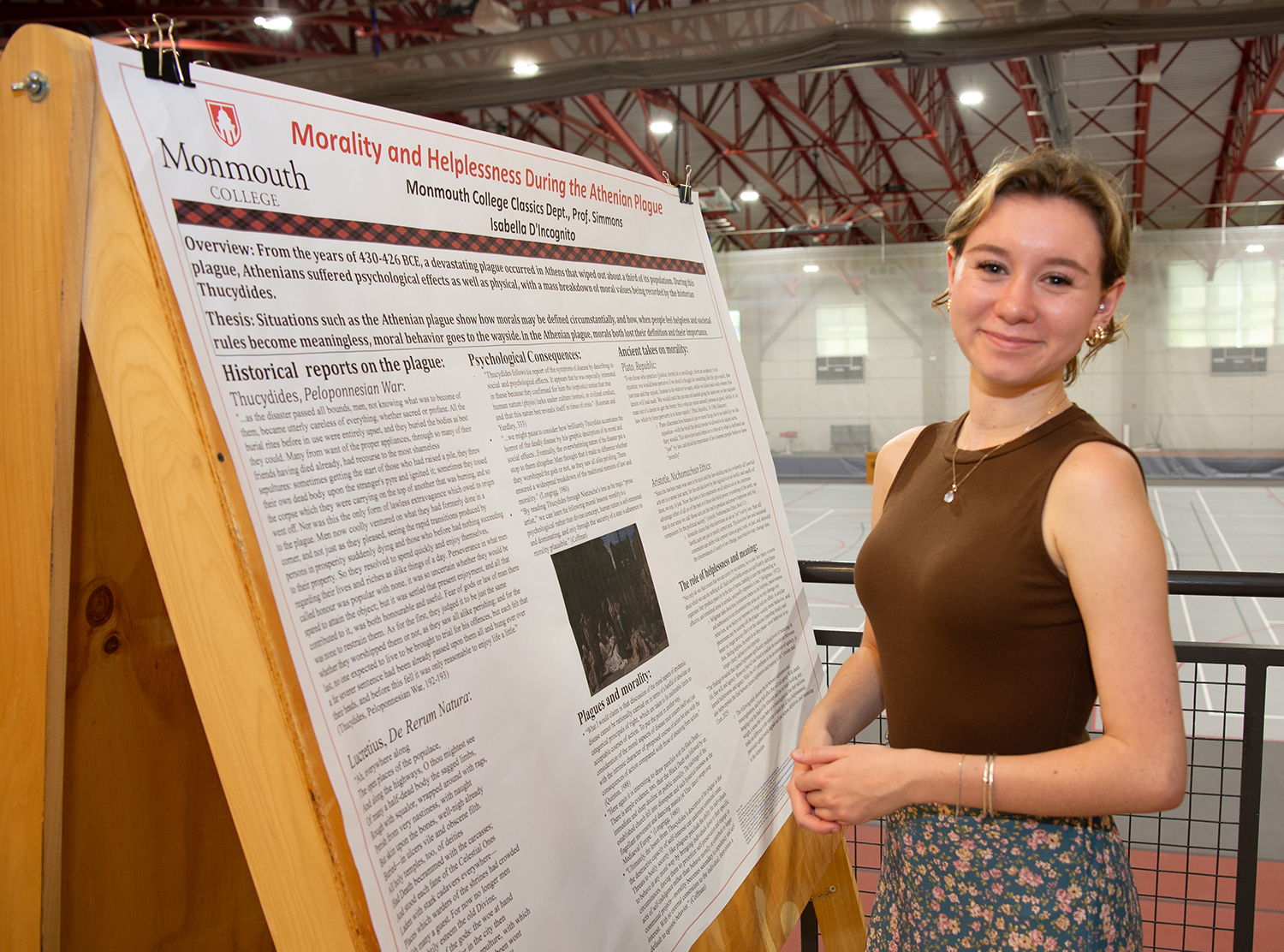
DOUBLE DUTY: Ella D'Incognito poses with her research poster about an ancient plague in Athens. She also displayed her psychology research on "dark romance," which she's also taken on the road to Chicago.
