Monmouth College students learn more than just chemistry during eight-week Doc Kieft program
Monmouth, Ill. (07/22/2025) — Of all the benefits that the late Richard "Doc" Kieft envisioned from his endowment to support Monmouth College science students, providing a cure for "imposter syndrome" might not have been high on the list.
But it's just one of many positive outcomes at Monmouth College from the Kieft Summer Research Program, an eight-week initiative that over the years has provided an opportunity for more than 100 students to participate in immersive, collaborative research with faculty each summer.
"Doc had a love of the college and a love of the students," said chemistry professor Audra Goach of Kieft, who died in 2009 after a 31-year career on Monmouth's faculty. "He was at all the athletic events, music events, plays. This was his life, and now it's his legacy."
Melissa Bivolarov '27 of Arlington Heights, Illinois - one of nine Kieft program participants this summer - shared a sentiment that perhaps some of the other 100+ students have experienced.
"This program has shown me that being a biochemist can be my reality," she said. "Up until now, I felt like an imposter, since I joined the biochemistry major later than my peers. However, working with the support of my research adviser (Goach) and my research group has shown me that people believe in me and that I should believe in myself, too."
Undergraduate research talks
In mid-July, Bivolarov joined the other eight participants in discussing their research, sharing how they decided on their topic, the methods and instrumentation required, and some of their early findings. Bivolarov's project is titled "Investigating the Effects of Honey on the Spermatozoa Plasma Membrane and Its Structural Relation to Fertility."
"I was able to find a very unique research topic and design a project that hasn't been explored before," she said. "There is available research that utilized honey, but none that investigated the relation between honey and the model membrane I designed. I learned how to use an instrument that I had never seen before, and now using it has become second nature to me."
Terra Stephens '27 of Belleville, Illinois, knows the feeling.
"I learned a lot about how to use different instruments," he said. "I always saw a rotovap (rotary evaporator) in the back of the room and thought, 'That's so interesting.' And now it's an instrument I use all the time." He said the experience has made him feel like "a real chemist."
Stephens is studying "Chalcone Synthesis via Aldol Condensation," which can contribute to the larger body of work on finding a cure for Alzheimer's disease. He made the next-to-last presentation by the Kieft students, followed by Kody Coyne '27 of Bluffton, Indiana, who discussed "Alternative Synthesis of Molecules Containing N-N Bonds."
"I've learned that being a chemist doesn't mean I have to sit in a stuffy lab all day doing boring reactions," said Coyne. "I can enjoy the work that chemists do and feel like I'm making actual contributions to the pool of human knowledge."
Chemistry professor Laura Moore echoed that comment in her opening remarks to those attending the talks, which included the parents of several of the participants, as well as members of the campus community.
"This is not a cookbook lab," she said of the research and the students' 40-hour workweeks. "This is research where you're discovering something."
Bee patient
Bivolarov was one of three students relying on the bees at the Monmouth College Educational Farm for her research. The others were Alayna Earle '27 of Clinton, Illinois, who studied insulin resistance, and Ivy Hawkins '26 of New Baden, Illinois, who is working with the propolis (a hive sealant) that the bees produce, hoping to advance it as a way to heal wounds and burns, particularly among people with diabetes mellitus, who are especially susceptible.
"I want to write a paper and publish it," said Hawkins, who focused on CAPE (caffeic acid phenethyl ester), the main bioactive component of propolis. It's known for its diverse biological activities, including anti-inflammatory, anti-cancer, antioxidant, antiviral and immunomodulatory properties.
Much of the research by this year's group of students continues projects started by previous Kieft participants. And the research figures to continue into Monmouth's fall and spring semesters for most, if not all, of them.
"I ran out of time - and insulin - but that just leaves a bunch of fun stuff to do in the fall," said Earle.
That timeline of years, rather than just days or weeks, shows another benefit of the program Doc Kieft created, which was articulated by Jesia Choity '27 of Bangladesh.
"Through the Doc Kieft program, I not only gained valuable hands-on research techniques but also began learning the importance of patience - something I'm still working on," she said. "As someone who struggles with patience, I've realized it's essential for a future in research. This experience has opened new doors and sparked ideas I didn't know I needed."
The other participants in this year's program, all rising juniors, include Rylie Bozarth of Pekin, Illinois, Julianne Drum of Iowa City, Iowa, and Chelsea Lyle of Farmer City, Illinois.
"I am so grateful for this experience and am grateful to have truly discovered my passion and see that I do belong with this group of people," said Bivolarov.
Media Attachments
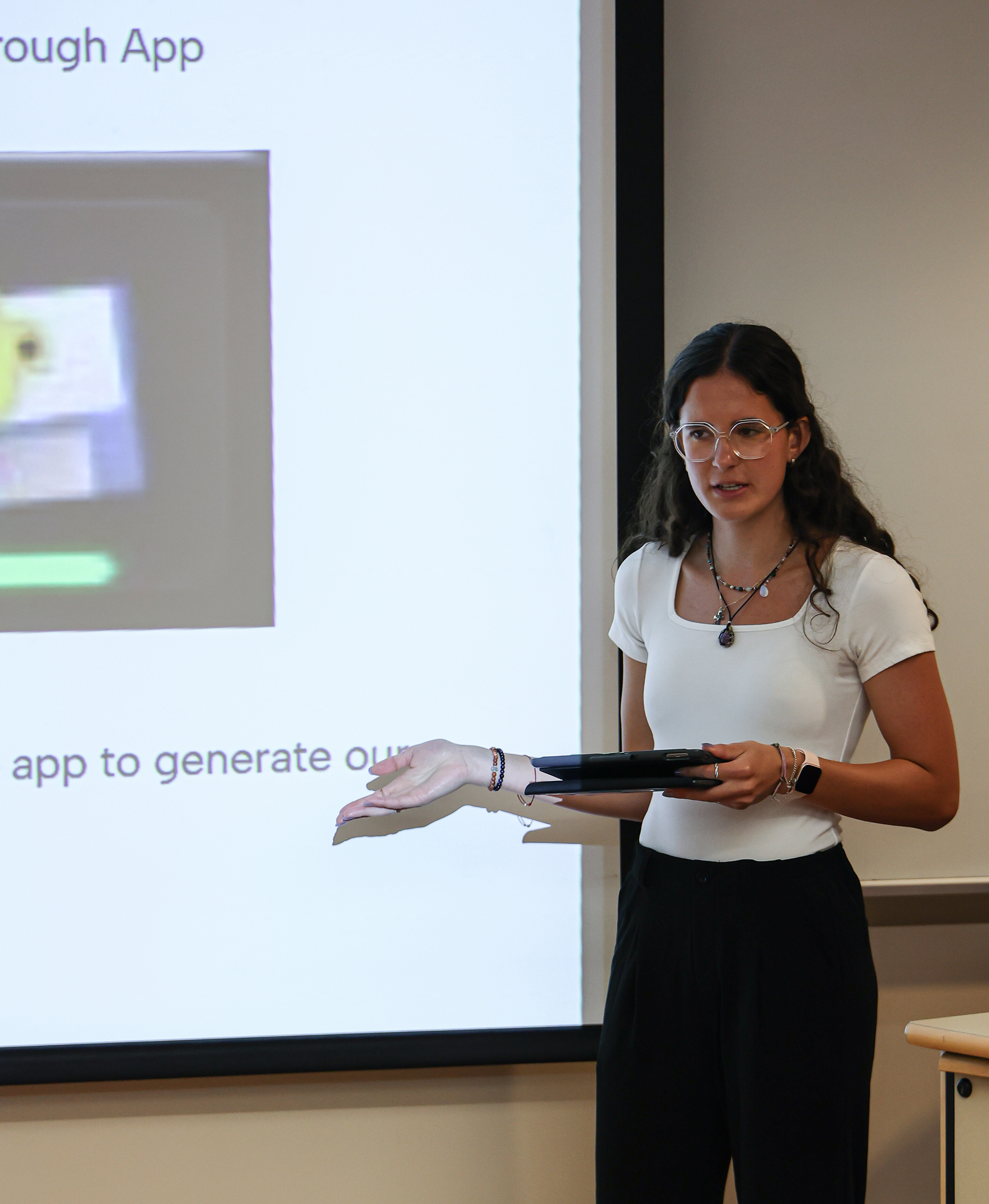
MELISSA BIVOLAROV: "I learned how to use an instrument that I had never seen before, and now using it has become second nature to me.”
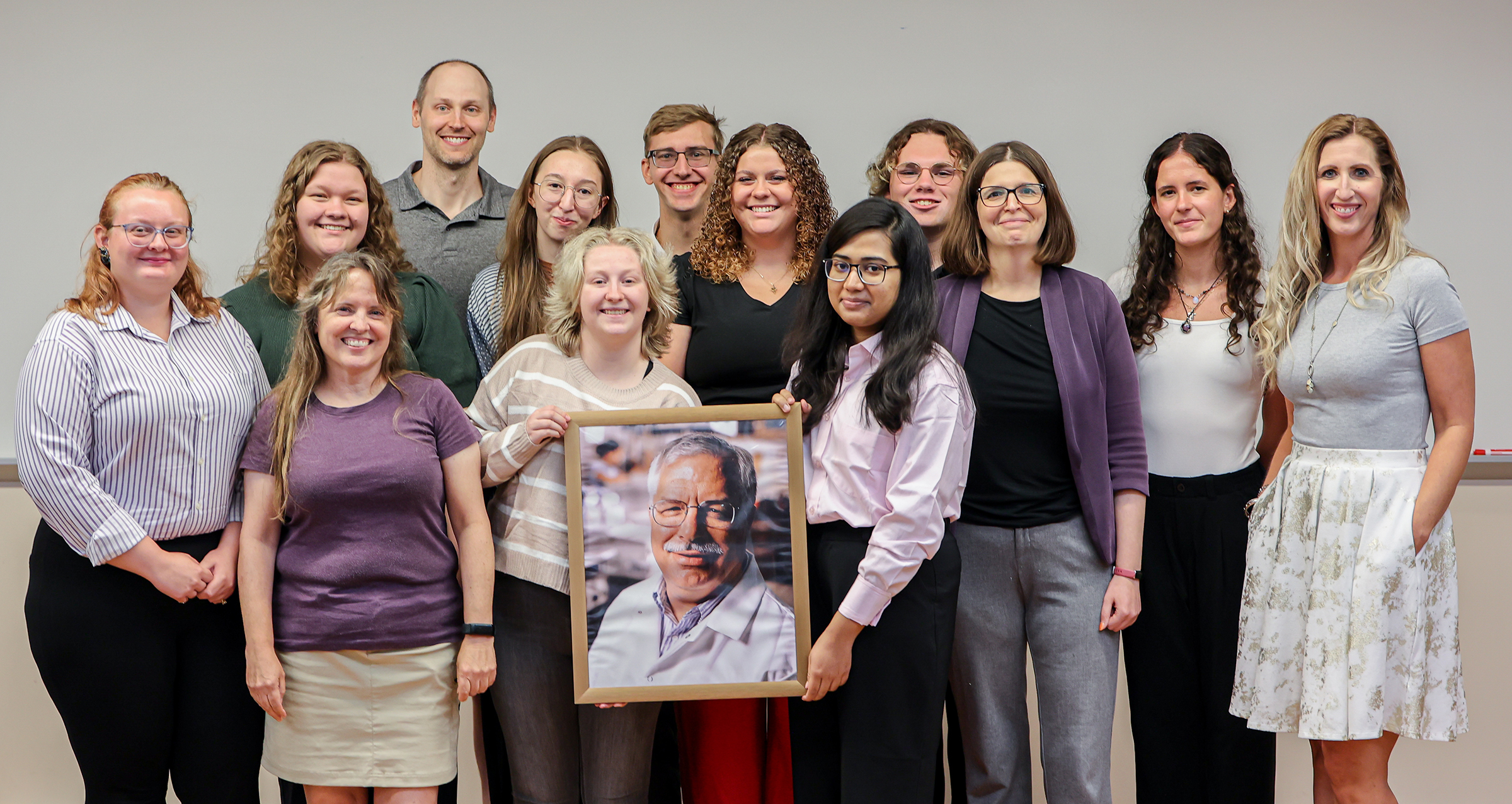
KIEFT PARTICIPANTS: In front from left are Ivy Hawkins, professor Laura Moore, and Chelsea Lyle and Jesia Choity (holding the photo of Doc Kieft). The rest of the group are, from left, Rylie Bozarth, professor Michael Prinsell, Julianne Drum, Kody Coyne, Alayna Earle, Terra Stephens, professor Janet Ugolino, Melissa Bivalarov and professor Audra Goach.