Monmouth students go back in time with 'surreal' visits to Berlin, Warsaw, Krakow
Monmouth, Ill. (06/08/2026) — Monmouth College's annual student trips are always memorable, with learning and tourism balanced throughout the time abroad. But that doesn't mean there aren't difficult moments along the way - whether that's completing one of professor James Godde's grueling mountain hikes, or negotiating language barriers, or even needing to spend several extra hours in transit in Iceland.
For the Monmouth students who traveled to central Europe May 19-28, the mountain to climb was a deep dive into the dehumanizing cruelty of the Holocaust.
"Our group got to go back in time and visit the places where the Holocaust took place," said Nick Plesko '29 of Streator, Illinois. "Seeing the Holocaust was very surreal for me. Often, I found the horror that took place in these locations unimaginable to even comprehend."
One of the trip's organizers, psychology professor Ryan Colclasure - who led the trip with his faculty colleague, Joan Wertz - knew what his students were in for, intentionally scheduling what he called a "palette cleanser" visit to Vienna, Austria. That came at the end of the trip after the students had made stops in Berlin - where they visited the Jewish Museum, among other places - Warsaw and Krakow. On the way to Vienna, they traveled through the Czech Republic and stopped in Olomouc to visit the city center and get lunch, providing what Wertz called a "bonus country" for the group.
Plesko had his own palette cleansing moment in the latter city.
"My favorite moment from the trip was in Krakow," he said. "I knew that its people suffered heavy trauma during the Holocaust with Auschwitz so close by. However, a group of classmates and I stumbled across a huge celebration for the city's soccer team that had just won a championship. We saw people of all races and religion come together to support the soccer team."
"This is the third time our program has done this trip based on World War II and the Holocaust, because it's such an important and educational experience," said Wertz. "I was particularly impressed with our students' reflections following the day we spent at the Auschwitz and Birkenau concentration camps."
The academic purpose
In preparation for the trip - which Colclasure said was designed to help students learn more about "the psychological perspective of what sorts of social and political factors led to the dehumanization" - the group read the books Night by Elie Wiesel and Maus: A Survivor's Tale by Art Spiegelman. The latter was written by the son of a Polish Jew and Holocaust survivor, while Wiesel's 1956 book became a No. 1 bestseller a half-century later when it was chosen for Oprah's Book Club.
Colclasure said the readings didn't fully prepare him or the students for what they saw.
"I thought I knew a lot, but to actually be there and see the suffering - to see the ovens where they could kill 2,000 people at a time - it was a really hard day," he said.
The prisoners who lived were subjected to "unimaginable horror," as well.
"Cruelty was the purpose," said Colclasure. "They wanted to keep them as filthy, as dehumanized as possible. The dark psychology of the Nazis was truly incredible from a psychological perspective. Our students are thinking about where the echoes of that history are now in today's world."
On a related note, Colclasure shared that antisemitism has been an issue in Europe for nearly a millennium and "it's on the rise again." But there are also indicators of a different time, such as the juxtaposition of members of the Monmouth group "drinking a latte macchiato on the same train line that the cattle cars full of people had taken."
The students also learned about World War II history, in general, including "how the Third Reich became so popular, so quickly," said Colclasure. "Germany had fallen on hard times, but Hitler told the people, 'This isn't your doing. It's the fault of the Jews.'"
In Poland, they learned that Warsaw, which was a favorite location for many of the students, was 85% leveled during the war. Meanwhile, Krakow wasn't, as Colclasure said its mayor pleaded, 'Don't level my city. I'll just give you the Jews.'"
Traveling abroad is life changing
"Seeing Auschwitz in person was meaningful because I grew up reading many Holocaust survivor testimonies and reflections," said Ruby Dickerson '28 of Galena, Illinois. "Visiting a concentration camp and traveling throughout eastern Europe made me realize how much of a broad span the Nazis covered and how detrimental the damage was to the Jewish population. You can read about it, but seeing everything in person was life changing. This was an unforgettable trip."
When Colclasure was the age of Monmouth's students, he spent 2-1/2 months traveling in Europe, an experience he, too, called "life changing."
"One of the things I told the students is that when you travel, you're living your best life," he said. "Everything is new, everything is exciting. You're highly focused and actively processing your surroundings. When you get back to your normal life, everything is more in focus. You can take that better life mindset and apply it in your areas at home. That's the goal and the challenge for the students who took this trip."
Plesko was certainly appreciative of the opportunity.
"This experience meant a lot to me because I was able to visit these locations to get deeper sense of connection and understanding to the historical events, and I was able to go through this with my peers who I also grew very close with as we experienced these things together and were able to form our own personal opinions."
Media Attachments
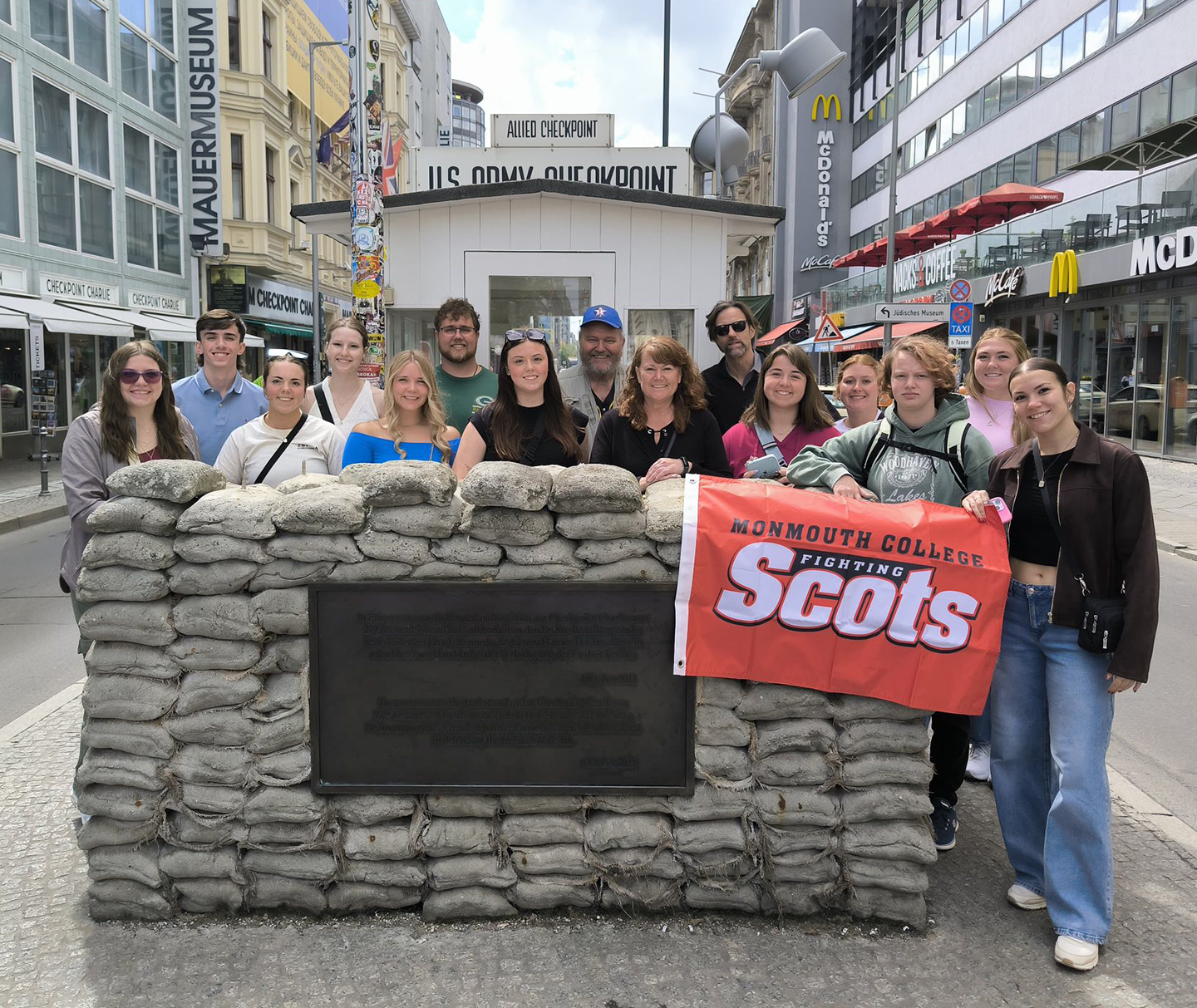
CHECKPOINT CHARLIE: The Monmouth group is pictured at the site that was the crossing point between West Berlin and East Berlin.
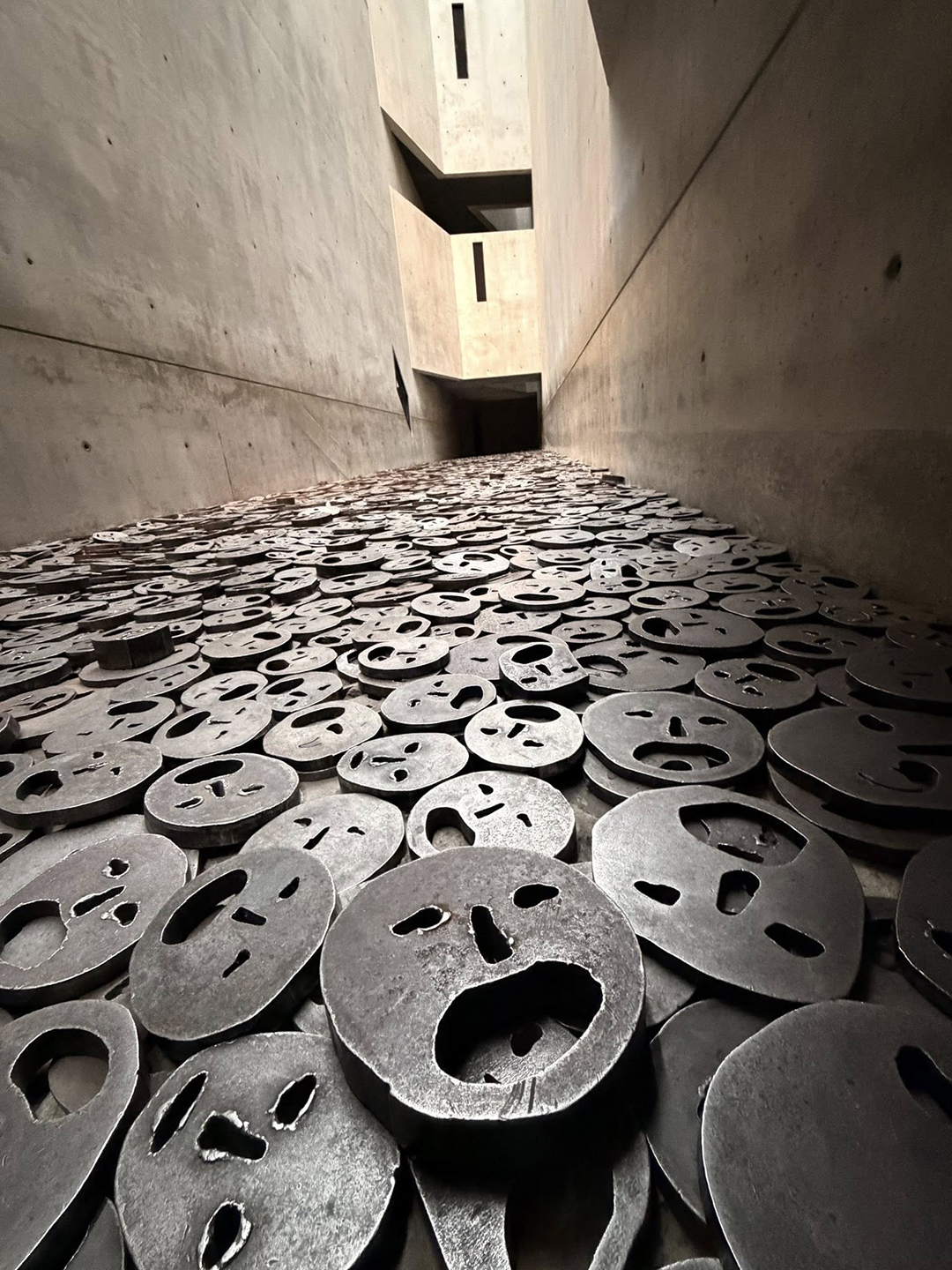
SHALEKHET (FALLEN LEAVES): This powerful installation where Monmouth students walked consists of over 10,000 heavy iron discs, each individually cut to resemble a screaming face, that blanket the floor of the Jewish Museum's "Memory Void."
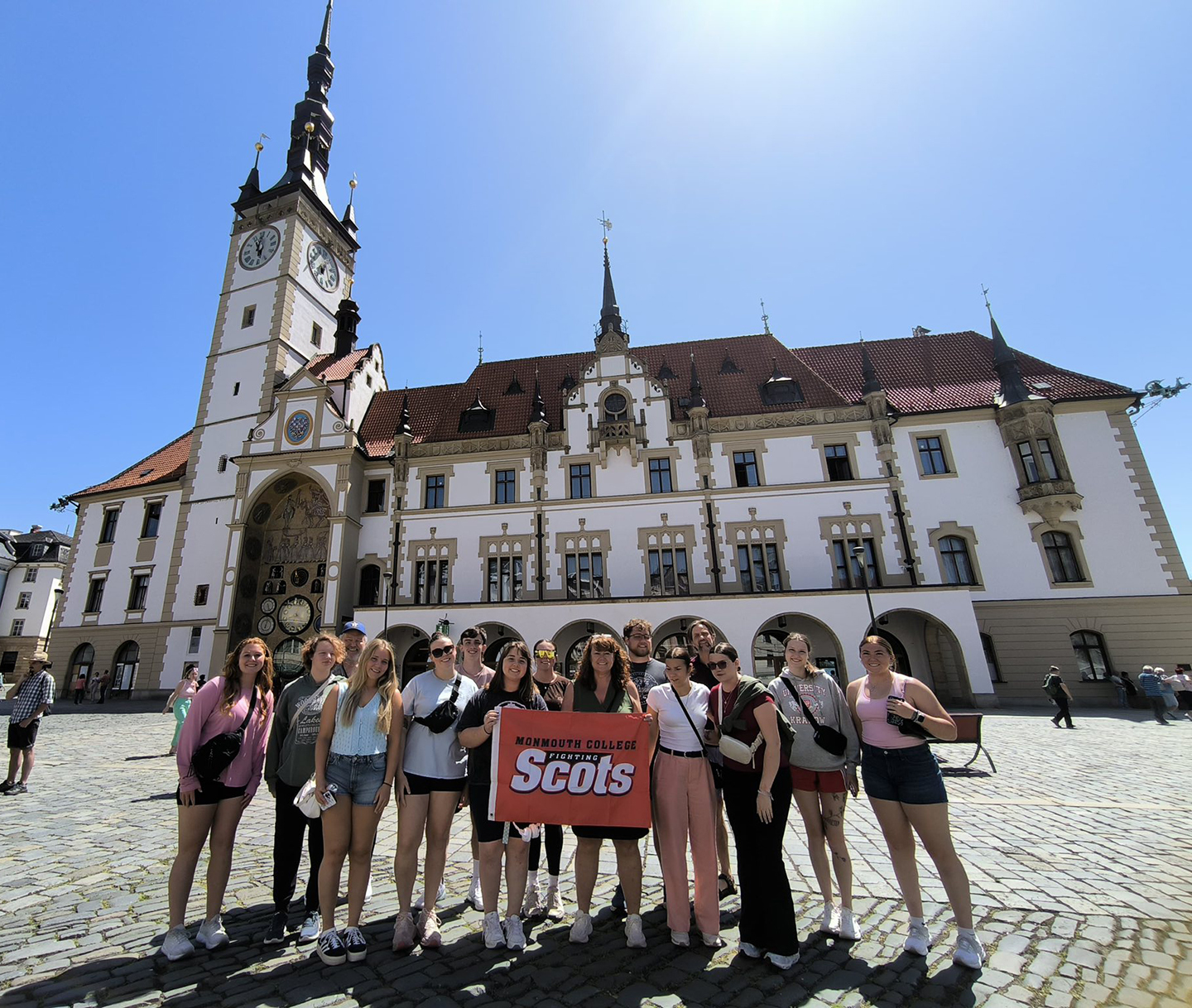
A BONUS CZECH-POINT: The group is pictured at the Town Hall in Olomouc, Czech Republic, where they stopped en route to Vienna.