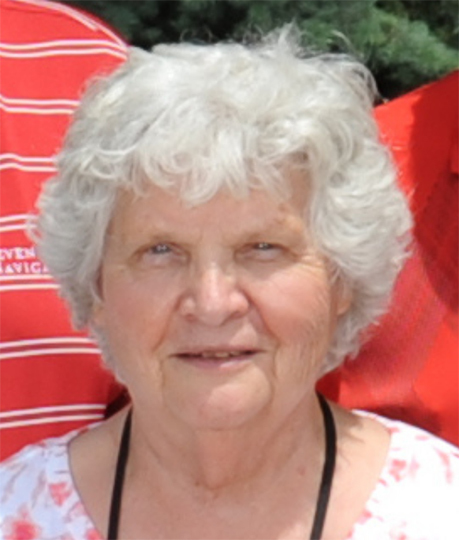
O'Hara '62 to be inducted into Monmouth College's prestigious Hall of Achievement
The former Julia Briggerman is a Woodruff graduate; achieved her career success at Dartmouth
Monmouth, Ill. (10/06/2025) — Pioneering women and Monmouth College go hand-in-hand, from the students who formed the first national sorority in 1867 right up to last month, when Fighting Scots kicker Mylee Hansen became the first female named to the D3football.com Team of the Week. Several of those trailblazing alumnae have been inducted into the Hall of Achievement, the highest honor Monmouth bestows upon its alumni.
The next person to receive that prestigious honor will be Julia Briggerman O'Hara '62. On the Friday night of Homecoming Weekend Oct. 17-18, she'll be recognized at the annual Alumni Impact Awards ceremony.
Before she was a trailblazer in biomedical research, O'Hara was a pioneer for women in science, breaking new ground as a member of the first class of women admitted to Ph.D. programs at Dartmouth College. She was the only woman in her research group - an experience she approached with humility and determination.
O'Hara completed her Ph.D. in 1969, launching a research career that paralleled Dartmouth's own growth into a major research university. Her early work explored porphyrins and their role in the body, ultimately leading her to specialize in photodynamic therapy - a light-activated treatment that enhances cancer therapy effectiveness. That remained a central focus of her work across decades of contributions to medicine, radiology and biomedical engineering.
O'Hara's advice to young scientists is simple yet profound: "You might start with an idea that's not necessarily brilliant, but it can open doors and lead you to a lot of new and interesting places." She's embraced retirement with the same curiosity and energy that marked her scientific career. Among her hobbies, she's a dedicated barbershop singer, cyclist and genealogist. Through it all, she's remained deeply connected to Monmouth, generously supporting the institution that first sparked her journey into science.
"Dr. O'Hara's lifelong pursuit of knowledge, service to science and continued support of Monmouth make her an exceptional candidate for the Hall of Achievement," said President Patricia Draves, herself a scientist before becoming a leader in higher education. "Her distinguished career reflects the highest ideals of leadership, resilience and intellectual rigor that our institution seeks to honor. It reminds us of the transformative power of a liberal arts education, and her story will inspire generations of students who follow in her footsteps."
The rest of her story
Throughout her career, O'Hara has crossed paths with many memorable individuals, but two stand out in particular for how she wound up as a Hall of Achievement inductee at Monmouth. One is Virgil "Tige" Boucher '32, who was part of the pipeline of successful athletes to come to Monmouth from Murphysboro in southern Illinois. Boucher became a successful football coach and teacher at Woodruff High School in Peoria, Illinois, influencing several Woodruff students to give Monmouth a try, including O'Hara.
"He talked to me about where I might go to school," recalled O'Hara of a conversation that would've taken place in the late 1950s. "And he was very excited to tell me about Monmouth."
That connection got her to campus. At her next stop at Dartmouth, Nicholas Jacobs played a major role.
"He was a junior faculty member in microbiology who always told me, 'Keep working, keep doing your thing, and eventually you'll do well,'" said O'Hara of Jacobs, who became a mentor, but is no longer "junior faculty." "He was very helpful, and he's still a professor at Dartmouth today. He's in his 90s now."
In between O'Hara's conversation with Boucher and her studies at Dartmouth were her four years as a Monmouth student. She took biology classes with Bob Buchholz, John Ketterer and Milton Bowman and worked several campus jobs, including serving as a "duty girl," which involved handling various tasks for her residence hall's dorm mother. But it was an off-campus experience that gave her an important new direction.
"I was going to go to medical school, and I came to Monmouth with that in mind," she said. "My senior year, I took part in the Argonne semester. A woman from Grinnell was going, and they needed a roommate for her. ... It was a good experience - it was a broadening experience. A visiting scientist spoke about how membranes are so important. It was fascinating to me. I decided I really wanted to do research. I got interested in molecular biology, which was really at its nascent stage then."
Also in its nascent stage was women playing a role in conducting that research. Dartmouth was no exception, as at the time it was an all-male school for undergraduates. But O'Hara found a home there and, importantly, support and encouragement from individuals such as Jacobs and her Ph.D adviser, the late Clarke Gray.
Asked if there was any resistance to her presence, or if, instead, everything ran smoothly, O'Hara replied, "It was a little bit of both. I would sometimes hear 'Why should I invest in you?'" referring to her family responsibilities, which ultimately kept her out of the lab for several years. "In a way, maybe they were right, but I came back and I worked hard," returning to Dartmouth as a research assistant.
O'Hara rose to the rank of research associate professor in diagnostic radiology and medicine and, even after her initial retirement, remained engaged in the scientific community, working for several years as a biomedical engineering research scientist at Dartmouth's Thayer School of Engineering.
The quest to cure cancer
That work settled in to the aforementioned photodynamic therapy. O'Hara, who has had cancer herself, commented on what research into the disease was like and what's changed.
"When I first started, they were just beginning to understand how cells work and how cancer develops," she said. "They used 'sledgehammer' methods,' treating all cancers and cancer patients like they were alike. It's important to understand that not all cancers are the same and that there's a need to individualize treatment."
Other progress has been made, as well.
"The crossing of fields is so important in cancer research," she said. "It's wonderful to see how much farther they've gotten, even since I retired. ... I always had encouraging colleagues and very talented students. In some small way, I contributed to their advancement and research. They worked with me and went on to do some wonderful things."
Media Attachments