Monmouth's Nolasco wins Blue Key's national research award for her work on Alzheimer's
The neuroscience and biochemistry double major is from Chicago's Jones Prep High School
Monmouth, Ill. (02/04/2026) — In 2022, Socorro Nolasco, the grandmother of Cassandra Nolasco '26, passed away. The cause was Alzheimer's disease, which Nolasco called "the most common form of dementia." The progressive neurodegenerative disease accounts for between 60-80% of all dementia cases.
That death of a close family member has fueled Nolasco's research efforts at Monmouth College, and her grandmother would be very proud to learn that her granddaughter just received a national award for it.
Blue Key, a century-old premier honor society that recognizes students at senior institutions of higher education, named Nolasco as the 2026 recipient of its inaugural Undergraduate Research Award. Nationwide, Blue Kay has 40 active chapters at colleges large and small.
'A brilliant research scientist'
A double major in biochemistry and neuroscience, Nolasco - who graduated from Jones College Prep, a selective-enrollment high school in downtown Chicago - works in the laboratories of chemistry professor Audra Goach and biology professor Janet Ugolino.
"Cassandra is a brilliant research scientist," praised Goach. "She has some of the best critical thinking skills I've seen in a student since I started teaching at Monmouth in 2006."
The more Nolasco has been involved in research - including a summer spent on campus through the Doc Kieft research program - the more she realizes that the deck was stacked against her grandmother. As of last year, an estimated 7.2 million Americans age 65 and older are living with Alzheimer's dementia. Women, she's learned, are twice as likely to be affected by Alzheimer's as men, and Hispanic and Black populations are at higher risks than average.
The gender issue, in particular, has driven Nolasco's research, as Goach explained.
"She immediately, upon researching peer reviewed literature, discovered the connection between Alzheimer's and hormone levels," said Goach. "It was a joy to discuss the planned experiments with Cassandra as she shaped her project, which utilized model membrane systems with me and with C. elegans (worms) as model systems with Dr. Ugolino."
"I think there's been good progress (with Alzheimer's research). We know more about it now," said Nolasco, who hopes future research will be more targeted to the populations most affected. "There are research articles dropping all the time, but we still don't know the cause of the disease."
One of her research posters, titled "Model Membrane Systems for the Investigation of Sex Hormones, Cholesterol and Sildenafil (Viagra) in the Progression of Alzheimer's Disease," hangs in the hallway of the chemistry wing on the third floor of the Center for Science and Business.
It seems counterintuitive, but in that research, Nolasco was actually searching for disorder as a good thing, and she found it with the Viagra, writing in her conclusion that it "disorders the membrane system, disrupting the formation of lipid rafts," which promote amyloid-beta protein buildup, a core feature of Alzheimer's disease. Estrogen, on the other hand, organizes the membrane system, promoting creation of the lipid rafts.
Nolasco also utilized Viagra in her neuroscience research.
"Ideally, I would have used testosterone in the experiments, but it can be pretty costly, so I used Viagra instead," said Nolasco. "I gave the C. elegans Viagra and watched what happened." In particular, Nolasco was observing the worms' "thrashing assay," which is done by placing worms in a liquid medium and counting the number of lateral swimming movements.
"Cassandra is extremely independent in the research lab and enjoys the process of discovery," said Goach, who noted that Nolasco has presented her work multiple times at the national American Chemical Society meeting. "Her knowledge of her research comes through, and her presentations result in very engaging discussions."
But not just a scientist
A member - and past president - of the Alpha Xi Delta women's fraternity, Nolasco is also involved with three honor societies, serving as president of Alpha Lambda Delta and vice president of Blue Key, in addition to being in Order of Omega through her Greek life membership. In her spare time, she even founded and serves as president of Scots Mariachi.
In particular, Nolasco wanted to stress Blue Key's role on campus, and how she and president Kamea Graham '26 of Chicago are working to call more attention to the honor society and increase its membership on campus. Founded on Nov. 27, 1924, Blue Key Honor Society bases its eligibility for membership on all-around leadership and integrity in student life, high scholastic achievement and service to others.
Choosing Monmouth, and beyond
"I wanted something different," said Nolasco of her college decision, which was strengthened by her cousin Celia Rodriguez '22 having a good experience at Monmouth. "I think I've had so many opportunities that I wouldn't have at a bigger school."
Many Monmouth chemistry students go on to major research institutions for graduate school, and Goach believes Nolasco is a prime candidate to continue that trend.
"Cassandra is smart, dedicated, hardworking, personable and innovative," she said. "I just wrote letters of recommendation for her for graduate school, and I'm positive that her research skills and dedication will put her in a position to be very successful."
Currently, Nolasco is weighing a grad school opportunity at Northern Illinois University, but there certainly may be more coming her way before she graduates from Monmouth in May.
Media Attachments
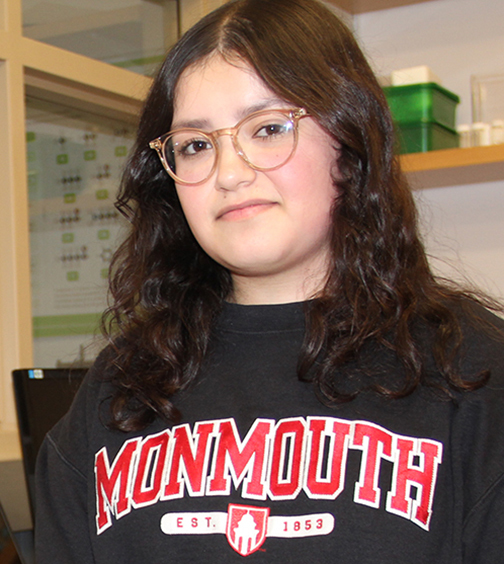
CASSANDRA NOLASCO: The neuroscience and biochemistry double major received Blue Key's national Undergraduate Research Award.
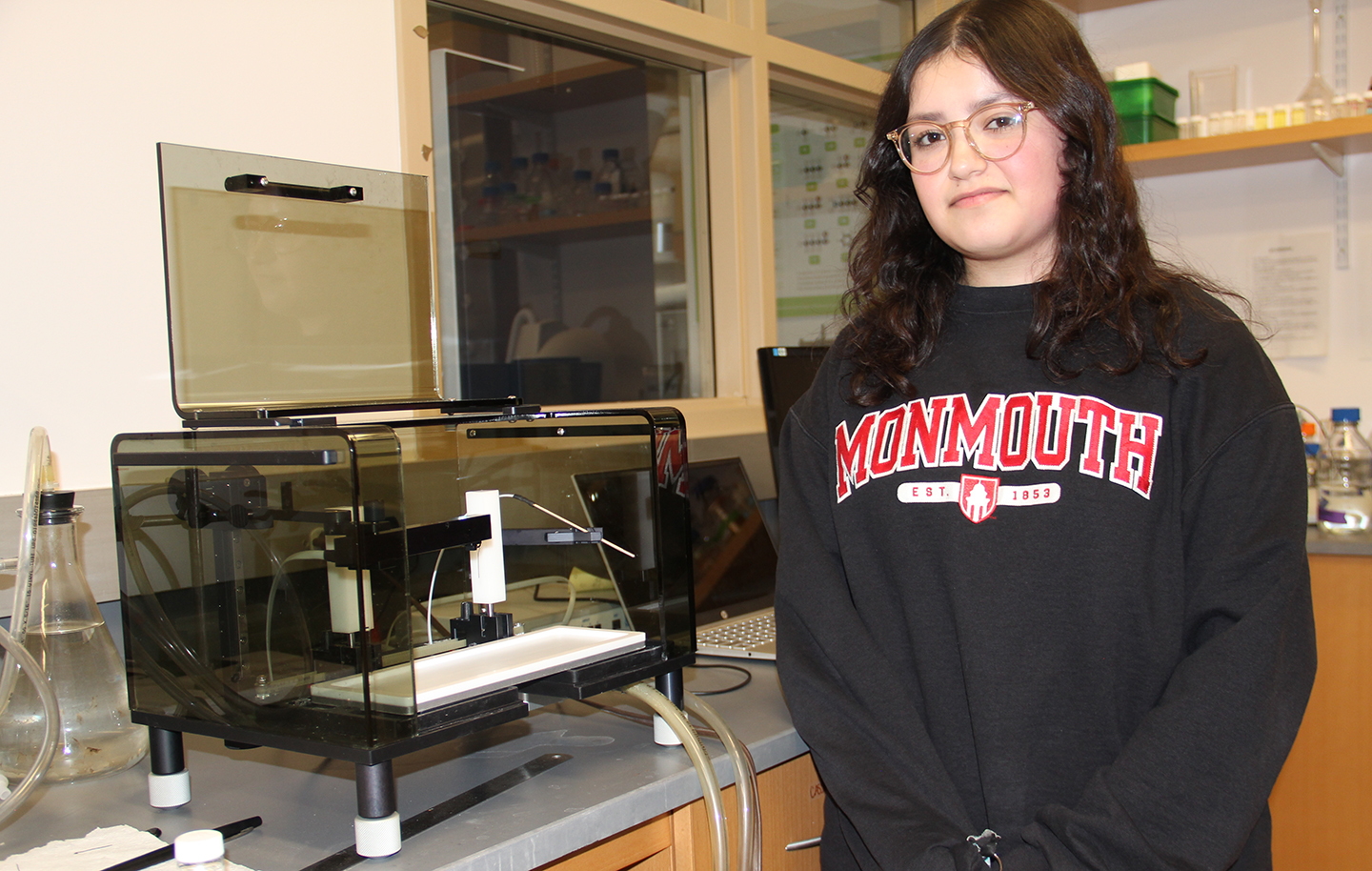

Monmouth College
Barry McNamara 309-457-2117, mcnamara@monmouthcollege.eduShare this Story


Recent News
- Volleyball Wins at Luther on Saturday
- Women's Tennis Finishes Season With Two Saturday Losses
- Kistler's Goal Leads Scots Past Ripon on Saturday
- Braun Accounts for Five Scores, Scots Win 63-7 at Beloit
- Men's Soccer Falls to Ripon on Saturday
- Scots Volleyball Swept at Cornell
- All Runners Deliver Season-Best Performances at Bradley's Pink Classic
- Monmouth College Senior Profile: Ivana Stefanova
- Men's Soccer Falls to Cornell on Thursday
- Scots Fall at IC on Tuesday