Mangieri leans on her liberal arts education as she leads research team at University of Texas
The 2002 Monmouth College graduate also attended high school in Monmouth
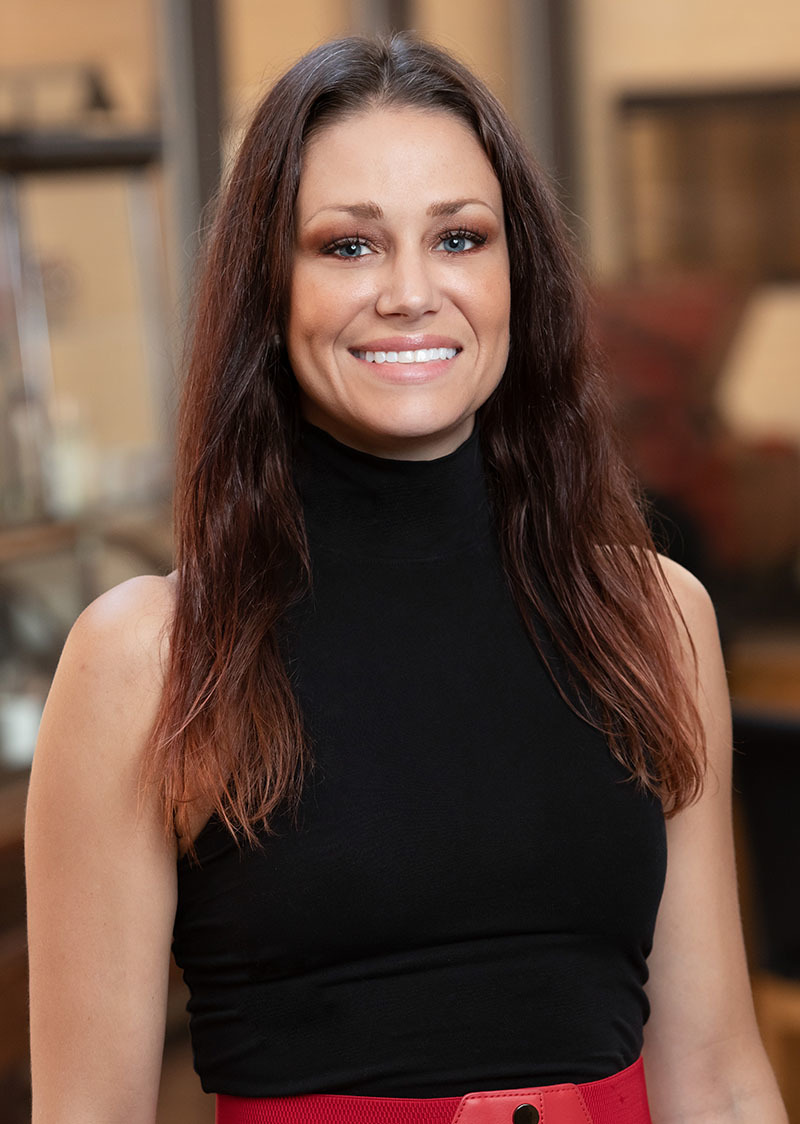
Monmouth, Ill. (04/30/2026) — An assistant professor in the Division of Pharmacology and Toxicology in the College of Pharmacy at the University of Texas, Regina Mangieri leads a research team at the university's Waggoner Center for Alcohol & Addiction Research. Her days are full of science.
But that doesn't mean economics isn't on Mangieri's mind, too. In fact, she said that's one of the major takeaways from her time at Monmouth College, where she was a summa cum laude graduate in 2002.
"I'm pretty sure I started as undeclared - that sounds like me - but then I chose art, because I was thinking about becoming an architect," said Mangieri, who attended Monmouth High School and deemed Monmouth the clear leader when it came time to pick a college not too far from home. To get into a math class she wanted, she changed her major to that subject, but that wasn't the long-term answer, either, although she did minor in it. Along the way, she took an economics class with Dick Johnston "on an impulse."
"I got so much out of it. It changed my entire life," she said. "I'm basically apolitical, but his class taught me there's no such thing as a free lunch. Here at the university, my colleagues might want to do some type of research or experiment, but how are we paying for it? How much will it cost? There's a trade-off between what you might want and the resources you have at hand. You can scale that on any level and in any field."
Another memorable class led by the "incredible" David Suda taught Mangieri about World War I history through the lens of the art, culture and music of the time. "I love the liberal arts education," she said. "I don't know if you'd get that type of course somewhere else."
Her Latin professor, Virginia Hellenga, also made an impact on her college journey.
"She had a powerfully positive influence on me personally at that time," said Mangieri. "We often chatted outside of class, and her encouragement, kindness and wisdom really helped to build my confidence freshman year. Now it's hard for me to remember what it was like to be that person, but at the time it was really transformative to have someone who made me feel like it was okay to strive to do big, important things with my life."
As Mangieri passed the midway point of her undergraduate education, she still needed to pick a lane.
"By my junior year, I remember thinking, 'I need to pick a real major.' I'd had 'Introduction to Psychology' as a sophomore, so I went with that," specifically the biological aspects of abnormal psychology, "which I found completely fascinating. Dr. (Joan) Wertz was really, really helpful during that time." Mangieri would've been an ideal biopsychology major, but the program wasn't added at Monmouth until shortly after she graduated.
Could she hack it?
Mangieri then headed west to the University of California-Irvine to obtain a Ph.D. in pharmacology. "I figured I'd work for a pharmaceutical company as a scientist developing drugs, and I'd be making six figures within the first few months. But I learned that's not how things worked" - another economics lesson.
"When I went to graduate school, I was the only one from a liberal arts college," she said. "I definitely remember that feeling from my peers - 'Is she going to be able to hack it?' But I outperformed them on almost every exam. I attribute that to the quality of education I received at Monmouth. For example, I only took one chemistry class in preparation for grad school: organic chemistry with Dr. (Pete) Gebauer. His lectures were so good that I not only retained the foundational knowledge that I gained from him, but I was able to apply it when I took more advanced courses as a Ph.D. student in pharmacology."
Monmouth prides itself on providing lessons that last, and Mangieri said that has certainly been the case.
"I'm so thankful for my professors," she said. "With a liberal arts education, you learn how to learn. That really stood out with me. It instilled in me a philosophy that it doesn't matter to me how much information a person might possess - are they willing and able to find the information to handle the task at hand. You don't have to be a specialist. You just have to be curious and be willing to learn."
Following Cal-Irvine, Mangieri did her postdoctoral training in Austin from 2008-13, during which time she received a National Research Service Award postdoctoral fellowship from the National Institute on Alcohol Abuse and Alcoholism (NIAAA). She currently heads major research within the NIAAA-sponsored Integrative Neuroscience Initiative on Alcoholism-Neuroimmune Consortium.
NIAAA funds are renewed every five years, and Mangieri has not only successfully achieved those renewals, but she's been able to establish some new funding sources, including the National Institute of Mental Health, further proof that economics is a major part of her science.
"I started as a staff scientist, but over time I've established my own independent ideas for research, which helped establish my overall independence," she said. "That's what funding agencies want to see. I have colleagues say to me, 'You have THREE major funding sources? Are you serious?'"
Alcohol and the brain
So what is it, exactly, that Mangieri is researching? A one-word answer is "neuropsychopharmacology" - an interdisciplinary science combining neuroscience and pharmacology to study how chemical agents influence brain function, behavior and mental states. Specifically, Mangieri is investigating alcohol-induced changes in cellular, synaptic and circuit physiology, and the relationship of those changes to the development of pathological behaviors.
Mangieri's research is showing that "alcohol affects the immune system in a way we're only beginning to understand. It's a very new field."
In one experiment, lab subjects were divided into two groups, one receiving Otezla - a prescription medication used to treat adults with moderate to severe plaque psoriasis - and the other a placebo.
"The group taking Otezla reduced the alcohol they were drinking," more so than the other group, she reported. "Why does Otezla reduce the amount of alcohol they drink? We're working on that."
Her research is also showing the effects of alcohol on inflammation and the immune system, and she continues to explore how early life trauma, coupled with genetic predispositions, leads to brain plasticity - the brain's ability to reorganize its structure, functions and connections in response to learning, experience or injury.
"Alcohol affects the brain. It's not just your liver that it affects - it's most organs," said Mangieri. "What should the common reader know about alcohol? It increases the risk for many types of cancer. It won't be long before we'll view alcohol use the way that smoking is viewed now. There'll be more of an understanding of the risks. That's my personal public service announcement."
Mangieri isn't making that statement from the moral high ground, as she doesn't abstain from alcohol. It's simply what the science is telling her.
"Alcohol use has a multitude of effects on the brain and physiological systems throughout the body," she said. "Determining which of these effects are the most important drivers of alcohol use disorder is still a major task that requires approaching the problem from many different scientific perspectives."
And thanks to Mangieri's solid background in interdisciplinary thinking, it's a challenge she feels uniquely prepared to meet.
Media Attachments

Monmouth College
Barry McNamara 309-457-2117, mcnamara@monmouthcollege.eduShare this Story


Recent News
- Volleyball Wins at Luther on Saturday
- Women's Tennis Finishes Season With Two Saturday Losses
- Kistler's Goal Leads Scots Past Ripon on Saturday
- Braun Accounts for Five Scores, Scots Win 63-7 at Beloit
- Men's Soccer Falls to Ripon on Saturday
- Scots Volleyball Swept at Cornell
- All Runners Deliver Season-Best Performances at Bradley's Pink Classic
- Monmouth College Senior Profile: Ivana Stefanova
- Men's Soccer Falls to Cornell on Thursday
- Scots Fall at IC on Tuesday